
When Symbols Become Reality

The pen hit the journal at 2 a.m. She wasn't writing words. She was drawing the same small circle, over and over, pressing harder each time until the paper nearly tore.
She didn't know why. It just felt necessary.
Three weeks later, she got the call she'd been waiting two years for.
Coincidence? Maybe. But neuroscience and manifestation research are starting to tell a very different story.
Your Brain Is a Symbol-Processing Machine
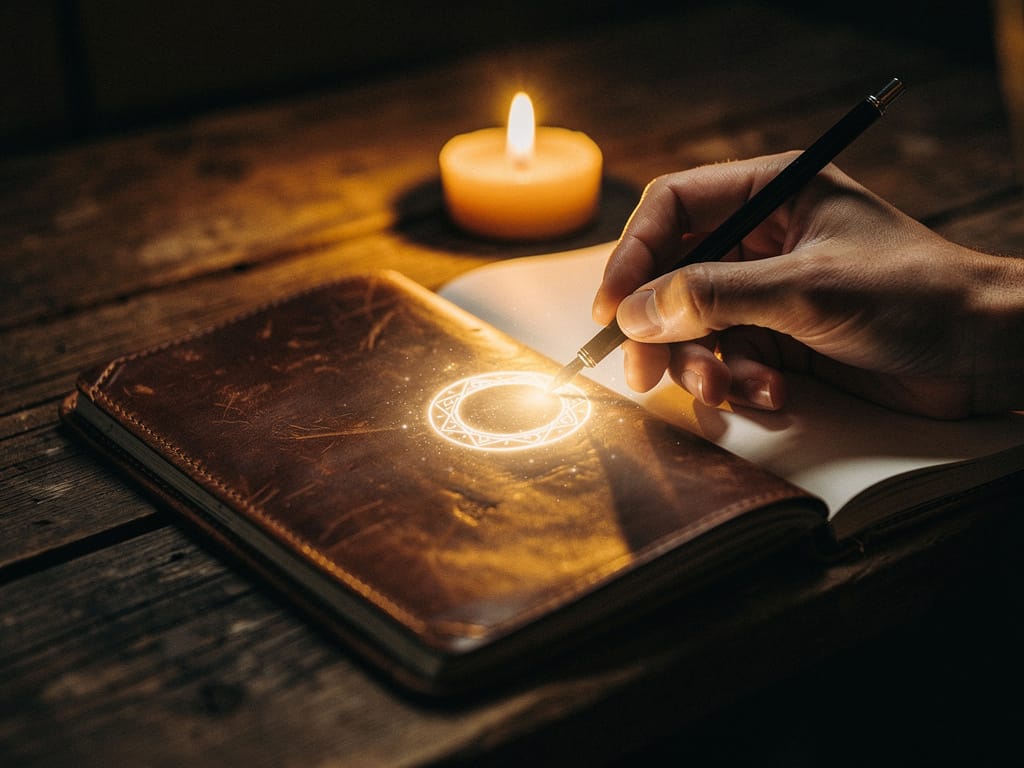
Here's something that'll shift how you see your own mind: your subconscious doesn't process language the way your conscious mind does.
It thinks in images, patterns, and symbols.
Carl Jung spent decades documenting this. He called these recurring symbols 'archetypes' - universal patterns that live deep in the collective unconscious, shared across cultures and centuries. The circle. The spiral. The rising sun. These aren't just pretty shapes. They're neurological shortcuts that bypass your rational, skeptical brain and speak directly to the part of you that actually drives behavior.
Why That Matters for Manifestation
Most people try to manifest through words. Affirmations. Journaling. Vision boards full of text.
But if your subconscious thinks in symbols, you're essentially sending it a message in the wrong language.
Think about it this way. When you see a red stop sign, you don't think the word 'stop.' Your body just... stops. The symbol bypasses the thinking layer entirely. That's the power you're leaving on the table when you ignore visual and symbolic work in your practice.
When a Symbol Becomes a Signal
Researchers studying the placebo effect have found something fascinating: the ritual surrounding a treatment often matters as much as the treatment itself. A pill that looks like medicine works better than one that doesn't. The symbol of healing activates the biology of healing.
Your brain can't always tell the difference between a symbol and the thing it represents.
Let that sink in.
This is why ancient traditions - from Egyptian hieroglyphs to Native American medicine wheels to Buddhist mandalas - all used symbolic imagery as a core spiritual technology. They understood, intuitively, what modern psychology is now confirming: symbols reshape inner reality, and inner reality reshapes the outer world.
How to Actually Use This
You don't need to be an artist. You don't need a ritual kit or a special altar.
Here's a simple starting point:
- Choose one intention. Not a list. One clear desire you're working toward right now.
- Find or create a symbol for it. It could be a shape you draw, an object you place on your desk, or an image you save to your phone's lock screen. The symbol should feel right to you - personal resonance is everything here.
- Engage with it daily. Not passively. Look at it with intention. For 60 seconds each morning, hold the symbol in your mind and feel the emotion of your desire already being real.
Key insight: The symbol isn't magic on its own. It's a trigger - a consistent signal you're sending your subconscious to keep orienting toward what you want, even when your conscious mind is busy with everything else.
The Shift You're Actually Making
When you work with symbols consistently, something subtle starts to happen.
Your reticular activating system - the part of your brain that filters what you notice in the world - begins tuning to frequencies aligned with your intention. You start seeing opportunities you were always blind to. Connections appear. Synchronicities stack up.
Is it magic? Is it neuroscience?
Honestly, at a certain point, the line gets beautifully blurry.
What matters is this: the woman drawing circles at 2 a.m. wasn't performing a ritual she'd read about. She was listening to something her conscious mind couldn't articulate yet. Her subconscious was already doing the work.
Yours is too. You just have to give it the right language.